mercredi 29 avril 2026

Le 6 juin 1944 Les parachutistes de la 101e airbonnes en Normandie

 Le 6 juin 1944, les parachutistes de la 101st Airborne Division — les célèbres Screaming Eagles — furent parmi les tout premiers soldats alliés à entrer en action en Normandie. Leur mission, dans la nuit précédant le Débarquement, était essentielle : sauter derrière les lignes allemandes pour sécuriser l’arrière d’Utah Beach et préparer l’arrivée des troupes débarquées au matin.

Leur mission dans la nuit du 5 au 6 juin

Vers 00h48–01h40, près de 6 900 parachutistes américains de la 101e sautent au-dessus du Cotentin dans le cadre de la Mission Albany, première phase de l’assaut aéroporté américain en Normandie. Ils sont transportés par plus de 430 avions C-47. Leur objectif est clair : empêcher les contre-attaques allemandes contre Utah Beach et ouvrir la voie à la 4e division d’infanterie américaine qui doit débarquer quelques heures plus tard.

Leurs missions principales sont :

  • s’emparer des routes et carrefours derrière Utah Beach ;

  • détruire ou neutraliser les positions allemandes menaçant la plage ;

  • sécuriser les sorties de plage (les chaussées permettant de quitter Utah Beach à travers les marais) ;

  • prendre des ponts et points de passage sur la Douve ;

  • isoler Carentan pour empêcher l’arrivée de renforts allemands.

Un saut très chaotique

Le saut de la 101e ne se déroule pas comme prévu. Les avions rencontrent :

  • un ciel couvert et du brouillard ;

  • une forte DCA allemande ;

  • des erreurs de navigation ;

  • des largages trop dispersés.

Résultat : les parachutistes sont éparpillés sur une zone bien plus vaste que prévu, parfois à plusieurs kilomètres de leurs zones de saut. Beaucoup atterrissent seuls ou en petits groupes, souvent sans radio, sans cartes, parfois dans les marais inondés où plusieurs se noient sous le poids de leur équipement.

Malgré le désordre, la mission réussit

Malgré cette dispersion, les parachutistes de la 101e accomplissent l’essentiel de leur mission grâce à l’initiative de petits groupes improvisés. Officiers, sous-officiers et simples soldats rassemblent les hommes qu’ils trouvent et attaquent immédiatement les objectifs les plus proches.

Cette désorganisation devient paradoxalement un avantage :

  • les Allemands ne comprennent pas l’ampleur réelle de l’assaut ;

  • de petits groupes américains frappent partout à la fois ;

  • les défenses allemandes sont désorientées.

Au matin du 6 juin, la 101e a déjà :

  • sécurisé plusieurs sorties d’Utah Beach ;

  • détruit des positions allemandes ;

  • coupé des routes de renfort ;

  • fixé les défenseurs allemands loin de la plage.

Un rôle décisif pour Utah Beach

L’action des parachutistes de la 101e est déterminante dans le succès du débarquement à Utah Beach. Grâce à eux, la 4e division d’infanterie peut sortir de la plage plus rapidement et avec moins de pertes que prévu. Leur action protège le flanc américain et empêche une réaction allemande coordonnée dans les premières heures critiques du Jour J.

En résumé

Le 6 juin 1944, les parachutistes de la 101e Airborne Division sautent de nuit en Normandie dans des conditions extrêmement difficiles. Dispersés, souvent isolés, ils improvisent, combattent en petits groupes et remplissent l’essentiel de leurs objectifs. Leur action est un élément clé du succès américain à Utah Beach et fait de la 101e Airborne l’une des unités les plus emblématiques du Débarquement.

On June 6, 1944, the paratroopers of the 101st Airborne Division—the famous Screaming Eagles—were among the very first Allied soldiers to see action in Normandy. Their mission, on the night before D-Day, was crucial: to jump behind German lines to secure the rear of Utah Beach and prepare for the arrival of the troops landing that morning.


Their mission on the night of June 5-6: Around 12:48–1:40 a.m., nearly 6,900 American paratroopers from the 101st jumped over the Cotentin Peninsula as part of Operation Albany, the first phase of the American airborne assault in Normandy. They were transported by more than 430 C-47 aircraft. Their objective was clear: to prevent German counterattacks against Utah Beach and clear the way for the 4th Infantry Division, which was to land a few hours later. Their main missions were:

• to seize the roads and crossroads behind Utah Beach;

• to destroy or neutralize German positions threatening the beach;

• to secure the beach exits (the causeways allowing access from Utah Beach through the marshes);

• to capture bridges and crossing points over the Douve River;

• to isolate Carentan to prevent the arrival of German reinforcements.

A very chaotic jump

The 101st Airborne's jump did not go as planned. The aircraft encountered:

• overcast skies and fog;

• heavy German anti-aircraft fire;

• navigational errors;

• drops that were too widely dispersed.

As a result, the paratroopers were scattered over a much larger area than anticipated, sometimes several kilometers from their drop zones. Many landed alone or in small groups, often without radios or maps, sometimes in flooded marshes where several drowned under the weight of their equipment. Despite the disarray, the mission succeeds.

Despite this dispersal, the paratroopers of the 101st Airborne Division accomplished the bulk of their mission thanks to the initiative of small, improvised groups. Officers, non-commissioned officers, and enlisted men gathered whatever they could find and immediately attacked the nearest objectives.

This disorganization paradoxically became an advantage:

• The Germans did not understand the true scale of the assault;

• Small American groups struck everywhere at once;

• The German defenses were disoriented.

By the morning of June 6, the 101st had already:

• Secured several exits from Utah Beach;

• Destroyed German positions;

• Cut off reinforcement routes;

• Pinned down the German defenders away from the beach.

A decisive role for Utah Beach

The actions of the paratroopers of the 101st Airborne Division were crucial to the success of the landing at Utah Beach. Thanks to them, the 4th Infantry Division was able to leave the beach more quickly and with fewer losses than anticipated. Their actions protected the American flank and prevented a coordinated German response in the critical early hours of D-Day.

In summary: On June 6, 1944, the paratroopers of the 101st Airborne Division jumped at night into Normandy under extremely difficult conditions. Scattered and often isolated, they improvised, fought in small groups, and accomplished most of their objectives. Their actions were a key element of the American success at Utah Beach and made the 101st Airborne one of the most iconic units of the Normandy landings.

Voici les photos / Here are the photos 


Merci de votre visite / Tank you for your visite


samedi 11 avril 2026

German 8 Ton Semi track 3.7cm FLAK37 SDKFZ 7/2 Tamiya Réf.35144 1/35

Bonjour,

Les invasions rapides des forces allemandes au début de la 2e GM connues sous le nom de Blitzkrieg ont mis en évidence l'efficacité du support aérien aux troupes au sol. Plus tard, au cours du conflit, les alliés s'octroyèrent la maitrise du ciel au dessus de l'Europe et les allemands furent concevoir et utiliser des systèmes d'armes anti-&aérien. La plupart de ceux-ci étaient constitués par le montage d'un canon anti-aérien sur le châssis d'un véhicule ayant fait ces preuves. Le SDKFZ 7/2 en est un exemple. Le remarquable canon Flak 37 fut monté sur le Half-track de 8 tonnes produit par la firme Krauss-Maffel. Le châssis du Half-track est une adaptation d'un châssis de camion standard avec à l'avant une suspension à lames et à l'arrière une suspension à lames et barres de torsion reliées au train de roulement, agencement typique sur des véhicules militaires allemands. Des plaques de blindages furent ajoutées au radiateur et à la cabine à partir de 1943. Le canon Flak 37 était un canon Flak 36 amélioré avec un nouveau viseur. Il fut le canon anti-aérien pour basse altitude standard tout au long de la guerre. Au total 123 SDKFZ 7/2 furent produits. 

Hello,

The rapid invasions by German forces at the beginning of World War II, known as Blitzkrieg, highlighted the effectiveness of air support for ground troops. Later in the conflict, the Allies gained air superiority over Europe, and the Germans developed and used anti-aircraft weapon systems. Most of these consisted of mounting an anti-aircraft gun on the chassis of a proven vehicle. The Sd.Kfz. 7/2 is one example. The remarkable Flak 37 gun was mounted on the 8-ton half-track produced by Krauss-Maffel. The half-track's chassis was an adaptation of a standard truck chassis, with leaf spring suspension at the front and a rear suspension of leaf springs and torsion bars connected to the running gear—a typical arrangement on German military vehicles. Armor plates were added to the radiator and cockpit starting in 1943. The Flak 37 gun was an improved Flak 36 with a new sight. It was the standard low-altitude anti-aircraft gun throughout the war. A total of 123 Sd.Kfz. 7/2s were produced.

Voici les photos, Here are the photos.


Merci de votre visite / Tank you for your visite.


vendredi 20 février 2026

GERMAN BOX CAR Type G10 IRONSIDE Réf:IR039 WAGON 1/35

 Bonjour,

Je vous présente un wagon à bestiau de l'armée allemande qui fera parti d'un convoi avec une locomotive et un wagon plateau qui transportera un Tiger I. En ce qui concerne le montage pas de difficulté particulier. Pour la peinture / patine voila ma démarche. Couche primer en premier, puis le châssis reçois une peinture XF76 Tamiya et pour les planches qui représente les parois une couche de LP 18 Tamiya. Les armatures de maintien des planches sont peint avec un gris moyen. Apres vernis de l'ensemble un wash est passé avec un mélange de peinture à l'huile Noir / Terre d'ombre brulée dans les creux. le toit reçois un marron rouge de chez Hobby color pois couche de vernis et après shipping de chez Mig. On passe un gris clair puis suit l"étape des éraillures avec une brosse. Les deux dernières techniques employés sont un brossage à sec avec une couleur à l'huile Abteilung 502 Réf 020 Faded dark pour les parois du wagon et un straking effect Mig 1206 pour les traces de pluies sur le toit.

Hello,

I'm presenting a German army livestock wagon that will be part of a convoy with a locomotive and a flatbed wagon transporting a Tiger I tank. The assembly itself presented no particular difficulties. Here's my approach to painting and weathering: First, a coat of primer, then the chassis received Tamiya XF76 paint, and the planks representing the sides received a coat of Tamiya LP18. The plank supports were painted with a medium gray. After varnishing everything, a wash was applied with a mixture of black and burnt umber oil paint in the recesses. The roof received Hobby Color reddish-brown, a coat of varnish, and finally, a Mig Ship paint. A light grey base coat is applied, followed by the scratching stage using a brush. The last two techniques employed are dry brushing with Abteilung 502 Ref 020 Faded Dark oil paint for the wagon walls and a Mig 1206 straking effect for the rain marks on the roof.

Voici le résultat / Here is the result


Merci de votre visite / Tank you for your visit


vendredi 30 janvier 2026

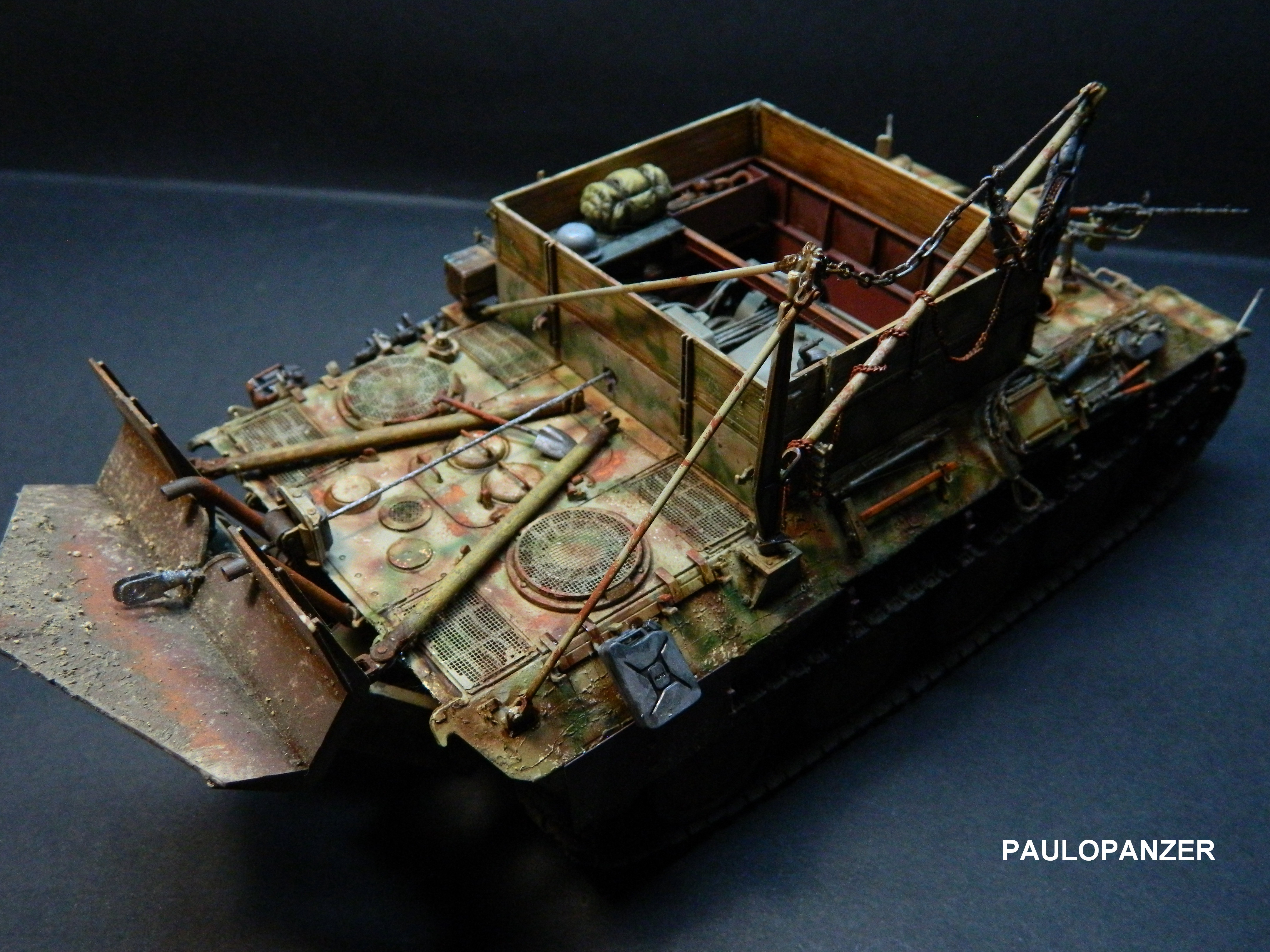
BERGEPANTHER Ausf A - MENG 1/35

Historique: Lorsque les premiers Tiger I et Panther ont été livrés aux troupes, il est vite devenu évident que les nouveaux véhicules de combat ne pouvaient pas être récupérés aussi facilement avec les véhicules de récupération existants. Deux Famo sont nécessaires pour sauver un Panther et trois Famo  pour un Tiger. 

A la fin de mars 1943, l'inspecteur général des forces blindées allemandes, le colonel général Heinz Guderian, ordonna la conversion d'un certain nombre de Panther en Bergepanther (Panther détourellé).

Comme l'affaire était urgente, MAN a été chargé le 10 mai de la même année de convertir dix Panthers en Bergepanther D.

Un treuil de 40 tonnes, une bêche et un armement mitrailleuse KwK38 de 2 cm étaient dans les plans de construction.

Les 12 premiers véhicules ont été fabriqués en juin 1943 et n'avaient ni treuil, ni bêche au sol, ni canon KwK38. la caisse correspond à celle d'un Panther D avec de petites modifications. L'ouverture était pourvue d'un couvercle en bois, au dessus il y avait un espace de stokage pour divers équipements.

Après cela, le Bergepanther sera sur un châssis de Panther A, et à été continuellement amélioré et équipé comme prévu au départ. Ainsi, les supports crées au devant de la caisse, destinées à pousser les véhicules en liaison avec une poutre de récupération, une grue de 2 tonnes, le treuil avec bêche de terre ainsi que la mitrailleuse KwK de 2cm prévu au départ avec les modifications correspondant ont été apportées. De plus, les écoutilles du conducteur et du passager ont été enlevées et une grande ouverture pouvant être recouverte d'une bâche a été ajoutée. il y avait de la place pour quatre personnes à l'avant du véhicule. Le cœur du Bergepanther était le treuil de 40 tonnes, développé par MAN à partir de 1940 et destiné à l'origine pour un véhicule amphibie pionnier, dont quatre exemplaires ont été construits. Le treuil n'a été que légèrement modifié et monté dans le Bergepanther. Il était entraîné par le moteur principal via un arbre à canne. Le treuil a été fabriqué par la Société Raupach .

Les Bergepanther ont été construit dans des versions A et G, de sorte qu'aucune conclusion ne peut être tirée sur la caisse utilisée, car afin d'augmenter la production de la version G, il a été de laisser également les caisses de type A dans la production. Les caisses n'étaient pas non simplement des caisses de Panther de récupération converties en Bergepanthers, mais également  des constructions indépendantes qui étaient fabriquées par plusieurs fabriquant différents. entre autres, ceux ci différaient dans sa version, le principal changement dans la version G était la bêche de sol révisé avec le bras de support étendus, ce qui a également entraîné un changement dans le système d'échappement avec des tuyères plus longs. Cependant il y avait aussi quelques Bergepanther avec une bêche de sol presque identique. Dans presque tous les versions Ausf G, le support de la mitrailleuse de 2 cm KwK 38 manquait, mais pas tous. Il y avait de nombreuses différences dans les deux versions, telle que la taille du réservoir de carburant, les supports attachés pour les outils, avec ou sans grue, la longueur des tuyaux d'échappement qui était adaptée aux différentes versions de bêche. Dans certains cas, des améliorations ont également été apportées aux véhicules plus anciens. Des Bergepanthers sans treuil étaient disponible dans les Versions A et G.

au total, 347 Bergepanther ont été fabriqués chez MAN, Henschel, et Demag, dont 46 sans treuil.

Maquette Meng: La maquette, je la trouve très détaillé par rapport à l'ancienne maquette Bergepanther Italeri. Les compartiments conduite et treuil sont bien détaillés dans son ensemble, malheureusement Meng ne fourni pas le moteur du blindé. tant pis, si on veut un Bergepanther avec un moteur, il faut choisir un Bergepanther Takom.

Le point faible de cette maquette et la simplicité de la chaine de levage et de la potence, Meng a mal appréhendé le sujet.

En tout cas sa reste une belle maquette à posséder pour tout passionnés de panzer


History: When the first Tiger I and Panther were delivered to the troops, it quickly became apparent that the new combat vehicles could not be recovered as easily with the existing recovery vehicles. Two Sd.Kfz were needed to save a Panther and three Sd.Kfz for a Tiger I. 9 tractors (Famo 18to) required.

At the end of March 1943, the inspector general of the German armoured forces, Colonel General Heinz Guderian, ordered the conversion of a number of panthers to Bergepanther.
As the matter was urgent, MAN was instructed on 10 May of the same year to convert ten Panthers into Bergepanther (ausf D).
A 40-ton winch, a spade and a 2 cm KwK 38 machine gun were planned in the construction plans.
The first 12 vehicles were manufactured in June 1943 and had no winch, spade or KwK 38. The hull matched the Panther Ausf D with small modifications. The opening was equipped with a wooden lid, on top there was storage space for various equipment.
After that, the Bergepanther on the chassis of the Panther A was continuously improved and equipped as originally planned. Thus, the square plates at the bow, intended to push the vehicles in connection with the recovery beam, a 2-ton crane, the winch with ground spade and the 2m KwK machine gun originally planned with the corresponding modifications were made. In addition, the driver and passenger hatches were removed and a large opening that could be covered with a tarp was added. There was now room for four people at the front of the vehicle.
The heart of the Bergepanther was the 40-ton winch, developed by MAN in 1940 and originally intended for a pioneering amphibious vehicle, four of which were also built. The winch was only slightly modified and mounted in the Bergepanther. It was driven by the main engine via a cane shaft. The winch was manufactured by the company Raupach in Görlitz and later in Warnsdorf/ Sudètes.
The Bergepanthers were built in the A and G versions, so that no conclusions can be drawn on the case used, because in order to increase the production of the G version, it was ordered to also leave the type A cases in production. The crates were not simply converted main tank crates, but rather independent constructions that were also manufactured by a different supplier to the main tank crates. Among other things, these differed in the division of the interior. (The main change in the G version was the revised ground spade with support arms extended, which also resulted in a change in the exhaust system with longer pipes. However, there were also some Bergepanther A with an almost identical ground spade. In almost all Ausf. G, the support of the 2cm KwK 38 was missing, but not all. There were many differences in the two versions, such as the size of the fuel tank, the brackets attached for the tools, with or without a crane, and the length of the exhaust pipes that were adapted to the different versions of the spade. In some cases, improvements have also been made to older vehicles. The Bergepanthers without winch were available in versions A and G. the attachment brackets for tools, with or without crane, the length of the exhaust pipes which was adapted to the different designs of the earth spur. In some cases, improvements have also been made to older vehicles. Bergepanther without winch was available in versions A and G. the brackets attached for the tools, with and without crane, the length of the exhaust pipes which was adapted to the different designs of the earth spur. In some cases, improvements have also been made to older vehicles.

A total of 347 Bergepanthers were manufactured at MAN, Henschel and Demag, 46 of which were winless. 

As for the Meng model, I find it very detailed compared to the old Bergepanther Italeri model. The driving and winch compartments are well detailed as a whole, unfortunately Meng does not provide the tank engine. Too bad if you want in a model the engine you have to take a Bergepanther Takom. 

The weak point of this model and the simplification of the chain of lifting and the stem, Meng has misunderstood the whole.

In any case its remains a beautiful model to own in his collection of panzer.

Voici les photos / Here are the photos


Merci de votre visite/ Thank you for your visit